 Trumpcoin
 vesting and the Three-Year $TRUMP Release Schedule
Trumpcoin vesting releases allocated $TRUMP over three years, with each allocation group following its own timetable. The published plan starts with 200 million tokens available on day one and reaches 1 billion over that period. Unlocking describes token availability, while a sale describes the use of released inventory.
What's inside
From Allocations to Released Inventory
An allocation’s assigned share and release dates determine the tokens covered by its vesting timetable. Once those tokens unlock, they join inventory available for later deployment or disposal.
Released tokens may remain held or enter a separately announced disposition program. The release timetable does not require an immediate sale.
Launch Availability and the Supply Ceiling
Launch availability covered 200 million $TRUMP, equal to 20% of the published maximum of 1 billion tokens. These quantities measure tokens, rather than dollar liquidity or the value of outstanding buy orders.
Public distribution and liquidity each receive 10% of the total allocation. Against the published maximum, each share corresponds to 100 million tokens. A liquidity allocation identifies a purpose within the distribution plan; it does not measure a pool’s dollar balance. Likewise, a public allocation describes a supply share without establishing its present ownership.
Creator Allocation and Ownership Concentration
The published allocation assigns 80% of total $TRUMP supply to creators and CIC Digital. The ownership disclosure identifies CIC Digital LLC and Fight LLC as collectively owning that allocation, subject to the three-year unlocking schedule. An 80% share of the published maximum corresponds to 800 million tokens.
The allocation chart describes the distribution design. Subsequent transfers, distributions, and sales can change recipient balances while the original allocation percentages remain the same. The concentration matters because recipient decisions determine how released inventory subsequently enters other hands.
Group Timetables Within the Daily Unlock Program
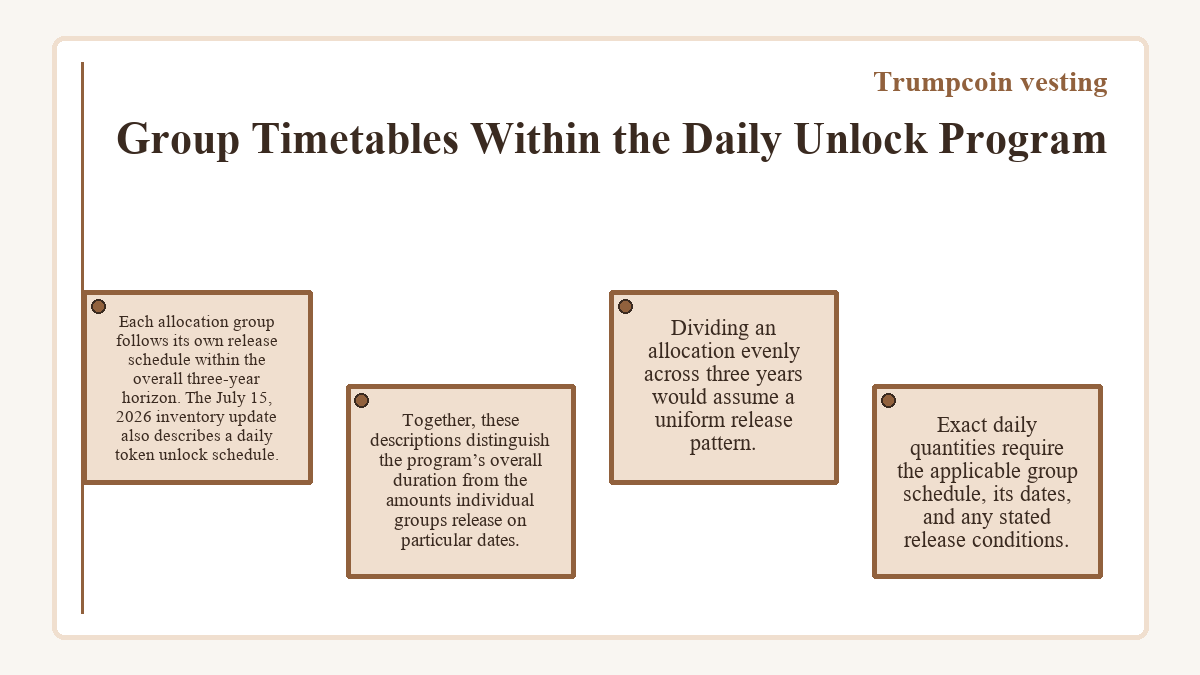
Each allocation group follows its own release schedule within the overall three-year horizon. The July 15, 2026 inventory update also describes a daily token unlock schedule. Together, these descriptions distinguish the program’s overall duration from the amounts individual groups release on particular dates. Dividing an allocation evenly across three years would assume a uniform release pattern. Exact daily quantities require the applicable group schedule, its dates, and any stated release conditions.
Does a Token Unlock Mean a Sale Has Occurred?
An unlock changes token availability under the allocation schedule, while a sale records a later disposition of released tokens. An unlocked balance can remain in inventory until its owner deploys, distributes, sells, or otherwise monetizes it. A transfer or program distribution can also change holdings without establishing an exchange sale.
Additional unlocked inventory can become available for sale, although a calendar alone establishes neither traded volume nor execution price. The inventory holder’s actions and available liquidity matter to actual market transactions.
The July 2026 Inventory Statement
Fight LLC’s July 15, 2026 market update reported approximately 67% of total $TRUMP supply as unlocked. It also reported that approximately 5% of previously unlocked tokens had been deployed, sold, distributed, or otherwise monetized since the February update. The first percentage uses total supply; the second uses previously unlocked inventory.
The combined activity category does not identify every token as a completed sale. Multiplying the reported 5% by the July unlocked percentage would also require matching their inventory bases and measurement periods. The disclosure does not establish that the previously unlocked inventory used for its activity calculation equals the unlocked total reported in July.
Neither historical percentage supplies a current circulating balance.
Planned Disposals From Existing Inventory
The July update expected less than 9.6% of total $TRUMP supply to be deployed, sold, distributed, or otherwise monetized over the following months, subject to market conditions. It specified already unlocked tokens as the source. Against the published maximum, that announced scope amounts to fewer than 96 million tokens.
The listed purposes included strategic partnerships, selective acquisitions, opportunistic disposals, and Coin Club or gaming initiatives. The update placed these activities in the same period as ongoing community initiatives. A Coin Club promotion consequently provides no basis for assuming creator inventory sales have stopped during the event.
The February 21, 2026 update had described an earlier plan involving less than 5% of total supply. Its date and total-supply denominator distinguish it from July’s report about 5% of previously unlocked tokens. The later forecast involving less than 9.6% of total supply described intended activity; it did not confirm completion of every proposed disposal.
Matching a Disposal Percentage to a Purchase Quantity
A purchase-cost estimate for a planned disposal volume starts by applying the stated percentage to its inventory base. In this hypothetical example, unlocked inventory contains 182,462,312 $TRUMP, and a planned disposal covers 5% of that inventory. The notice’s inventory basis determines which balance belongs in the calculation.
Multiplying 182,462,312 by 0.05 produces 9,123,115.6 $TRUMP. Applying the same percentage to the 1 billion maximum would produce 50 million tokens, describing a different scope. Changing the denominator changes the implied volume even though the percentage stays at 5%.
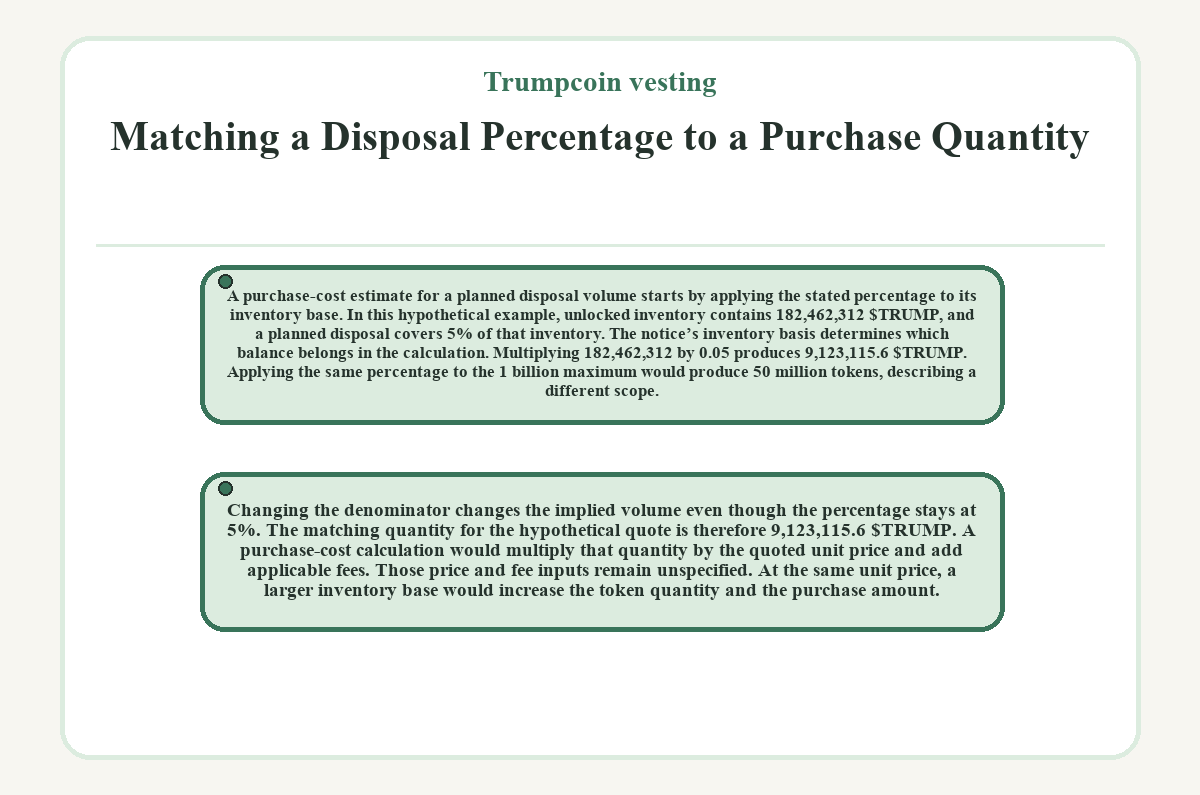
The matching quantity for the hypothetical quote is therefore 9,123,115.6 $TRUMP. A purchase-cost calculation would multiply that quantity by the quoted unit price and add applicable fees. Those price and fee inputs remain unspecified. At the same unit price, a larger inventory base would increase the token quantity and the purchase amount.
One Supply Across Solana and TRON
The Solana and TRON versions represent the same $TRUMP with different network addresses. Their presence on separate networks does not establish two independent allocations of 1 billion tokens. A network balance and the overall allocation schedule describe different scopes, so they cannot be added together as separate supply ceilings.
TRON DAO’s July 28, 2025 deployment announcement identified LayerZero’s Omnichain Fungible Token standard and Stargate Finance as the cross-chain framework. It described transfers within a unified supply. Network-specific addresses identify the relevant token instance; the supply ceiling belongs to the shared token model. A balance on one network alone cannot establish the program’s aggregate unlocked inventory.
Coin Club Holding Periods and Allocation Vesting
Coin Club scores reflect qualifying holdings over event windows, while vesting governs allocation release. The Returning Champions boost uses a qualifying prior score and continuing holding conditions. It contributes ranking credit without creating a scheduled token payment to the member. Event eligibility can therefore change when holdings change, even though the creator allocation continues along its separate release timetable.
Liquidity Incentives and Released Inventory
Liquidity incentives describe tokens deployed into a participation program, separately from the schedule releasing allocation inventory. Fight LLC’s July 15, 2026 update reported over 114,000 $TRUMP deployed as Kamino campaign incentives for liquidity provision. That campaign-level figure does not specify each participant’s individual receipt. The update also described pool growth from $2,000 at launch in March 2026 to a May 2026 peak of $1.66 million. Those dollar values describe pool liquidity, while its incentive deployment counts tokens: over 114,000 $TRUMP.
Trumpcoin vesting questions, answered
-
Does the 0.14% Compensation Allocation Apply Separately to Each Service Provider?
- The three service providers share the disclosed 0.14% compensation allocation as a group. The allocation description places their compensation under the same unlocking schedule. It does not assign 0.14% to each provider or state their individual proportions, so the combined percentage alone cannot determine each provider’s token allocation.
-
Are Purchases Refundable If an Unlock Coincides With a Price Decline?
- The published terms describe Trump Meme transactions as final and non-refundable. The Coin Club terms also exclude compensation for token purchases, market losses, or changes in leaderboard ranking. Those provisions do not create an unlock-related refund mechanism when a release date coincides with a falling market price.
-
Does Creator Vesting Give Every $TRUMP Holder a Share of Trading Revenue?
- The trading-revenue disclosure identifies CIC Digital LLC and Celebration Cards LLC as recipients, without defining a revenue share for every token holder. Celebration Cards LLC owns Fight LLC. The release percentages describe token allocations; they do not specify a dividend rate on publicly held $TRUMP.
-
Must a Public Buyer Wait Three Years Before Trading $TRUMP?
- The published three-year schedule concerns allocation releases, while the project describes $TRUMP as freely tradable on the blockchain. It does not describe a universal three-year resale lock for public purchases. An event’s requirement to maintain a qualifying balance concerns that event’s benefits and scoring.
-
Is an Allocation Unlock a Staking Reward?
- An allocation unlock releases tokens under a distribution timetable; a reward pays tokens under a separate participation program. The Kamino campaign described incentives for liquidity provision, with its own participation context. A vesting date or allocation percentage does not state a staking rate or promise income to a passive $TRUMP holder.
-
Who Chooses the Execution Timing for Sales of Unlocked Inventory?
- The General Terms modified May 11, 2026 allow an independent third-party custodian or broker to determine timing, price, and volume for disposals it executes. This is a possible execution arrangement. Under that arrangement, Fight LLC, CIC Digital LLC, and their affiliates lack day-to-day control over individual sales.